
Implications of the Trump-China Trade War on the United States and the Development of a Common Understanding between the USA, China and the EU
The two sides last met in Geneva in May, where they agreed to a 90-day pause on the more than 100% base tariffs that each side had levied on the other as the trade war escalated. Some U.S. tariffs imposed during a previous trade war during Trump’s first term have remained in place on Chinese goods as well.
China retaliated against U.S. tariffs by halting more of its exports of rare earths, the refining of which it has a near monopoly on. Beijing has been quietly restricting the export of rare earths to the U.S. and European Union since 2024 but in recent weeks has cut off even more minerals. Chinese customs data show rare earths exports by value have dropped by more than 20% this year compared to the same period last year.
The U.S. tried to squeeze China by banning software for making semiconductors, gases like ethane and butane, and nuclear and Aerospace components, people familiar with the bans said. The U.S. proposed banning Chinese students from the country as part of a plan to increase pressure on China before the presidential call between Mr. Trump and Mr. Xi.
On the call, Mr. Xi warned that the leaders of the United States and China needed to “steer clear of various disturbances or even sabotage,” seemingly a reference to the idea that critics of China in Mr. Trump’s government had driven some of these efforts without his knowledge. One person with knowledge of the effort said the actions were done by Mr. Trump.
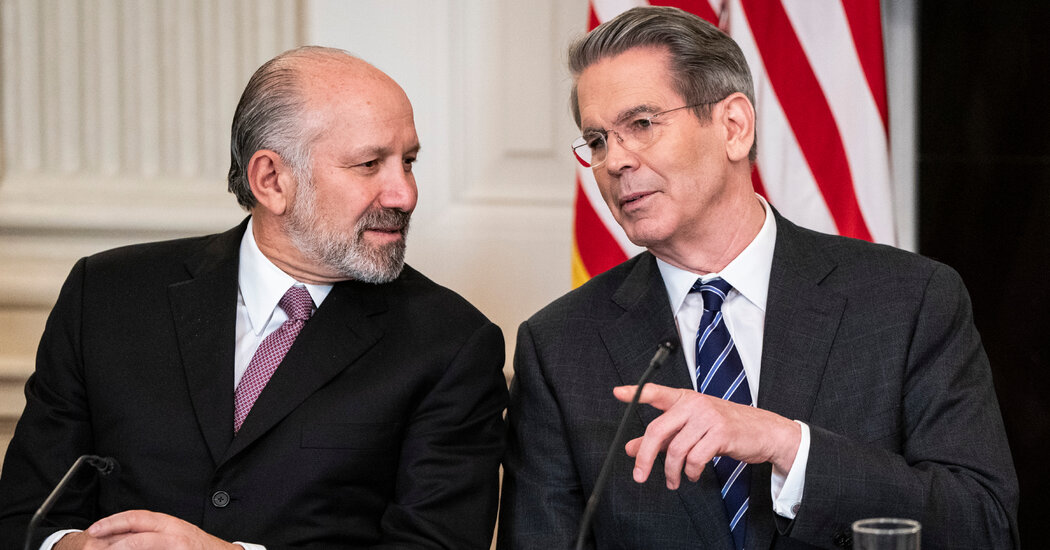
Talks continued into a second day Tuesday, with three of Trump’s top aides attending. Commerce Secretary Howard Lutnick, Trade Secretary Scott Bessent and Trade Representative Jamieson Greer are in London, with Chinese vice premier and lead economic representative He Lifeng representing Beijing.
Li Chenggang, a vice minister of commerce and China’s international trade representative, said the two sides had agreed in principle on a framework for implementing the consensus reached between the two leaders and at talks in May in Geneva, the official Xinhua News Agency said.
The two sides sought to build on negotiations in Geneva last month that agreed to a 90-day suspension of most of the 100%-plus tariffs they had imposed on each other in an escalating trade war that had sparked fears of recession.
The U.S. and China have sparred over a wide range of issues since the talks, from visas for Chinese students at American universities to rare earth minerals that are crucial to many industries.
Trump spoke at length with Chinese leader Xi Jinping by phone last week in an attempt to put relations back on track, then announced the trade talks would resume in London.
But while China has said it would be willing to set up an expedited “green channel” for companies needing rare earths, it has also signaled it will not completely ease its powerful grip on the world’s supply of refined rare earth products, saying its export controls are “driven by its domestic industrial sustainable development needs,” according to a commentary published this week by the country’s state news agency.
The U.K. government is providing venue and logistical services for the talks, but it is not involved in them. We welcome the talks because we know that a trade war is not in anyone’s interests and we are a nation that supports free trade.
China’s commerce minister Wang Wentao had a talk with Britain’s business secretary in London. A statement from China’s commerce ministry said Wang called for both countries to uphold the multilateral trading system, and he wanted to see greater cooperation between China and Britain on finance and sustainability.
Overall, U.S. tariffs on goods from China still remain higher than those imposed on other countries. The U.S. cut its tariffs on Chinese goods to 30% while China cut them to 10%.
Two-Flavor US-China Trade Negotiations: Yu Jie and the China-US Correspondence in London (after the Geneva Trap)
The relationship between the two countries deteriorated after their tentative truce inGeneva, which each accused the other of violating.
Yu Jie, senior research fellow on China at London’s Chatham House international affairs think-tank, warns that we “should not hold our breath for any major progress” following the talks, with both sides unlikely to offer any further tariff reductions. We are currently in the deep water of trade negotiations between Beijing and Washington. China is aware of the importance of maintaining the rare earth export controls. On the other hand, the United States wants to slow down China’s technological advancement.
Yu says the two sides will have to talk through some of these thornier sticking points over the next few days. Lutnick said Tuesday he expects the talks to go on “all day.” He told reporters the talks were “going well” and “we’re spending lots of time together.” The Chinese delegation is in London all week and there is a chance of talks going on beyond Tuesday.
The second round of tariffs between the US and China will be held in Lancaster House, a mansion in the U.K. Investors and world leaders are watching these talks closely to see if they can help thwart the prospect of a deepening trade war between the world’s two biggest economies.