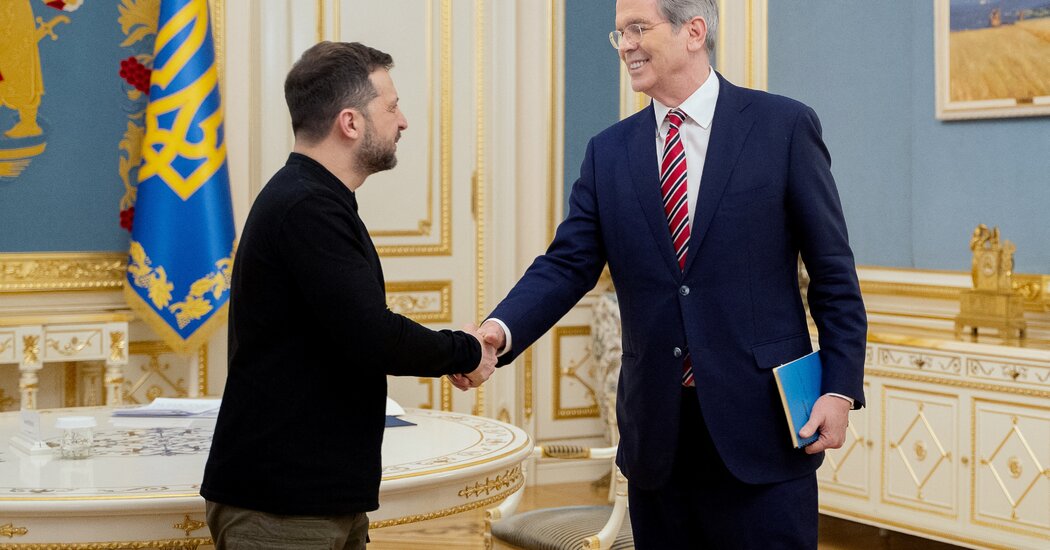

Reconstruction Investment Fund for Rare-Earth Metals in Ukraine: Ukrainian President Volodymyr Zelensky and the U.S.
The metal’s strength-to-weight ratio and resistance to heat make it crucial for aerospace. Titanium is used in the F-35 joint strike fighter’s engine parts to absorb the high temperatures generated during supersonic flight. During the 1960s, the U.S. had to secretly source titanium from the Soviet Union to build the SR-71 spy plane.
Europe’s largest battery is estimated to be in Ukranian, or 3% of global total reserves. However, none of Ukraine’s lithium is being mined at present. Mining would require hundreds of millions in investment.
Ukraine — described by the World Economic Forum as “a key potential supplier of rare earth metals” — is believed to hold about 5% of global rare-earth metal reserves, a group of 30 substances classified as “critical raw materials” by the European Union.
“It’s clear that Europe, Japan, and the United States are all dependent on China for rare earth elements,” Serhiy Vyzhva, director of the Institute of Geology at Taras Shevchenko National University of Kyiv, said in an interview.
A draft of the agreement calls for Ukraine to contribute half of all revenues from minerals, hydrocarbons, oil, natural gas “and other extractable materials” to a Reconstruction Investment Fund, jointly owned and managed by the U.S. and Ukraine to be “reinvested at least annually in Ukraine to promote the safety, security and prosperity of Ukraine.”
President Trump told his cabinet on Wednesday that President Volodymyr Zelensky of Ukraine was expected to come to Washington to sign a framework agreement enabling the United States to share in the country’s mineral wealth, but he insisted the United States would not be providing security guarantees to Ukraine in return.
Weak security agreements are familiar to the Ukrainians: In December 1994 they agreed to the “Budapest Memorandum,” in which they gave up their nuclear weapons — inherited from the old Soviet Union, and still controlled from Moscow — and the United States, Britain and Russia agreed “to respect the independence and sovereignty and the existing borders of Ukraine.”
Most of the mineral wealth inUkraine is found in the “Ukrainian Shield”, which is also known as Luhansk, according to a report co-authored by Muggah.
Nearly half of Ukraine’s power-generating capacity has been decimated by the war, according to the Center for Strategic and International Studies. Mining, one of the most energy-intensive industries, faces major obstacles, with companies hesitant to invest in the face of ongoing security risks.
Zelensky’s Security Guarantees: Why Europe and America are Frustrated by the Russian War in the Cold War? An Analysis of Mr. Trump
China is the world’s largest producer of titanium, but it is not the top producer of the mineral. Russia, Australia, and Canada are major suppliers. The U.S. has relatively small titanium mines in Utah and Virginia.
China dominates the world’s production with 75% of the supply and holds the largest reserves. One of the largest deposits in the world, and one of the smallest producers, is thought to be in Ukranian.
Nickel, a silvery-white metal used in alloys like stainless steel, is critical in battery and jet engine production. The Democratic Republic of Congo is the largest producer of cobalt, an important metal used in rechargeable battery electrodes and a range of other commercial and industrial applications.
Obtaining such guarantees from Washington, the only nuclear-armed power truly capable of standing up to Russia, had been Mr. Zelensky’s central demand. His greatest worry is when he’s forced into a cease-fire, but Russia uses the time to rebuild and attempt to seize his country again.
He said at his first cabinet meeting that he wouldn’t give security guarantees beyond very little, while discussions of the dismissal of government workers and Musk’s role in the administration dominated the meeting. Europe is going to do that.
Mr. Trump was silent about what role the US would play in trying to deter Russia from restarting the conflict. He stood silent when the president of France brought up security guarantees at the White House news conference.
And Mr. Trump’s statement may cement Europe’s fear that he has essentially switched sides in the war, and is seeking a broader normalization of relations with Russia. The prospect that Europe may find itself in the position of supporting Ukraine and continuing to isolate Russia, while Mr. Trump takes the opposite position, has rattled NATO allies and led the incoming German chancellor, Friedrich Merz, to declare that Germany must seek “independence from the U.S.A.”
The European Security Force: Why the Russians aren’t going to stop blaming us for what they do, and what we can do about it
“I call it an economic security guarantee,” Mr. Bessent said last weekend. He is in negotiations with Mr. Zelensky and his aides.
European officials are not sure of what a force might look like. But the purpose and shape of the force could make a very big difference.
The kind of force Mr. Trump talked about might need more than 100,000 troops, much bigger than the armies of Britain, France and Germany. It would be an observer force if it were 10,000 troops, but it would only observe violations and report them.
An even smaller force could be a “tripwire” that would bring in a larger response to any military moves by the Russians, but that only works if the United States and its allies are prepared to respond.