
Beyond the Wall Street Wall: The Implications of the Comprehensive Trade Warfare for the Economy, the Financial Crisis, and the First Presidential Recession
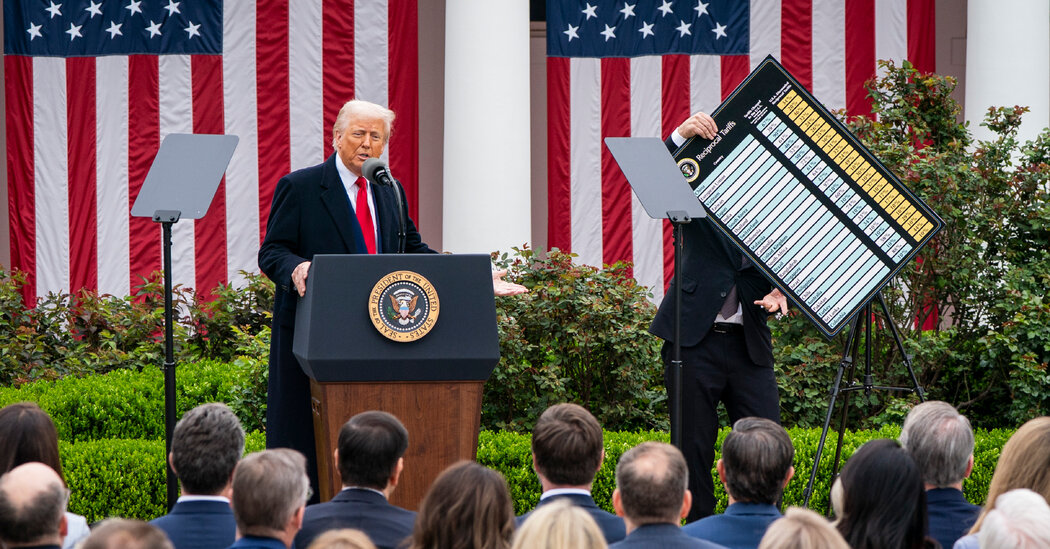
This all pales in comparison with the tariffs Mr. Trump enacted Wednesday. It is, of course, too early to judge the full economic effect and thus the political fallout. It’s too early to know the final policy of the Trump administration. For the same reason, many of Mr. Trump’s supporters will give the policy a chance. His approval rating may not fall overnight.
If anything, Mr. Trump and the Republicans today could be especially vulnerable, as so much of his political strength is built on the economy. He usually got the best ratings on his handling of economic issues as a politician. He’s benefited from his reputation as a successful businessman and from effective economic stewardship in his first term. He won the last election despite his enormous personal liabilities because voters were frustrated by high prices and economic upheaval that followed the end of the pandemic.
In New York Times/Siena College national surveys last fall, more than 40 percent of voters who backed Mr. Trump in 2024 but not 2020 said that the economy or inflation was the most important issue to their vote.
As a result of the sweeping baseline and “reciprocal” tariffs, searches for “recession” have surged, and economists at prominent investment banks have pointed to increased odds of a recession occurring.
In a research report last week titled “There Will Be Blood,” JP Morgan upped its risk of a global recession to 60% from 40% before the tariff announcement.
Its CEO Jamie Dimon doubled down on Monday, writing in his annual letter to investors that the tariffs “will likely increase inflation” and are prompting “many to consider a greater probability of a recession.”
There are growing calls for Trump to delay or reduce the tariffs coming from voices on Wall Street, Capitol Hill and around the world. Administration officials said on Sunday that more than 50 countries had reached out to start negotiations, but that the tariffs would not be changed.
In an interview with NBC’s “Meet the Press” on Sunday, Treasury Secretary Scott Bessent downplayed concerns about a recession, saying, “We’re going to hold the course.” He said that there is no reason why we need to price in a recession after the March jobs report.
Since World War II, the average length of a recession has been 11.1 months, according to the business publication Kiplinger. The US has experienced recessions every 7.5 years since the end of World War II.
Instead, the NBER’s Business Cycle Dating Committee — made up of top American economists — has been declaring the beginning and end of the cycles since its creation in 1978 (NBER itself is decades older).
The longest post-WWII recession was the Great Recession, which spanned 18 months from December 2007 to June 2009 and was triggered when the U.S. housing bubble burst. The most recent was the brief COVID-19 recession in 2020. While the economy experienced two quarters of negative GDP growth in early 2022, fueling fears of a recession, NBER did not declare one.
An overview of the Depressions that the U.S. had last experienced in 1930s and 1930s: A brief but timely note on “The Implications for Entrepreneurship and the Economy”
For example, people may not want to spend as much, which can impact the businesses they would otherwise support, which can lead to layoffs and in turn harm companies’ performance in the stock market — further fueling the cycle.
According to the dictionary, a depression is defined by widespread unemployment and major pauses in economic activity. NBER does not say what type of depressions the U.S. has experienced, but it does say that it is generally thought to have last experienced one in the 1930s.